
Influence - Eric Wu
Butane and oxygen mixed as the flint ground against a metal wheel, sparking the edge of a loosely rolled cigarette and burning slightly on the joint of his index finger. Thus, the exothermic reaction began, as the rolled paper from the last blank page of his math notebook turned into carbon monoxide. Complex organic molecules in the faded chocolate-brownie-like filling underwent catabolic reactions and broke down into monomers—only it wasn’t cocoa powder and sugar; it was nicotine and tar. Clusters of fresh and uncontaminated alveoli caught the tar, turning the lung tissue sticky as nicotine traveled through axons and bound to neuron receptors; adrenaline spiked the nerves. It was the early summer of 1987, two weeks before his final high school exam, the world felt full of nausea but also a slight, just-so-little, yet ever-growing sense of excitement, after my father had his first taste of a cigarette.
Throughout the '50s to '80s in China, all private tobacco firms were nationalized and treated as natural monopolies. Farming and production of tobacco were highly profitable; with government subsidies and utilizing the economies of scale, the cost of production per unit was capped to mere cents. On the demand side, due to the rationing system in the mid to late 20th century, just two cigarette coupons could purchase 400 units of cigarettes. Ironically, despite the shortage of grain coupons, there were more cigarettes available at cheaper prices than grains.
The idol effect also rose, as little regulation was imposed on smoking in movies and television. The poster of the once-popular mafia movie A Better Tomorrow hung right in the center of my father’s bedroom. The prominent Hong Kong actor Chow Yun-Fat, in his black cashmere blazer with shaded pilot sunglasses, held a skinny white cigarette in his mouth, igniting a 100-dollar bill. In an era with limited access to information, virtually no one knew the right and wrong of smoking as cigarettes slowly became integrated into social customs.
Did the 17-year-old him consider smoking because of the pervasive influences of his classmates, diners in restaurants, solo moviegoers who sat in the side aisles of cinemas, and even airline passengers (though he had never been on a plane at that age)? And maybe, by a fraction of a chance, hanging a cigarette in his mouth would have made him less of a book nerd with rounded-frame glasses and more of a shaded-pilot-sunglasses guy. Or maybe, tobacco was really amazing, reaching his adrenaline threshold again and again, temporarily, and so briefly, kicking away all his stress—from his final high school exams to the bursting of the economic bubble in 1994 when he worked at the Bank of China.
As the millennium approached, the smoking population and lung cancer rates peaked, causing government healthcare expenditures to double, far exceeding the profits generated by cigarettes. All those banal but necessary policies came—taxation, higher age restrictions, medical advertisements, and anti-monopoly measures for state-controlled tobacco firms. Free-market regulations only addressed the issue from an economic perspective, but not for my father's lungs or my upbringing. In a powerful promise in the new year of 2015, my father quit smoking and never touched a cigarette again. It seems that, over the 28 years my father was a smoker, both the society and he moved on from those influential illusions.
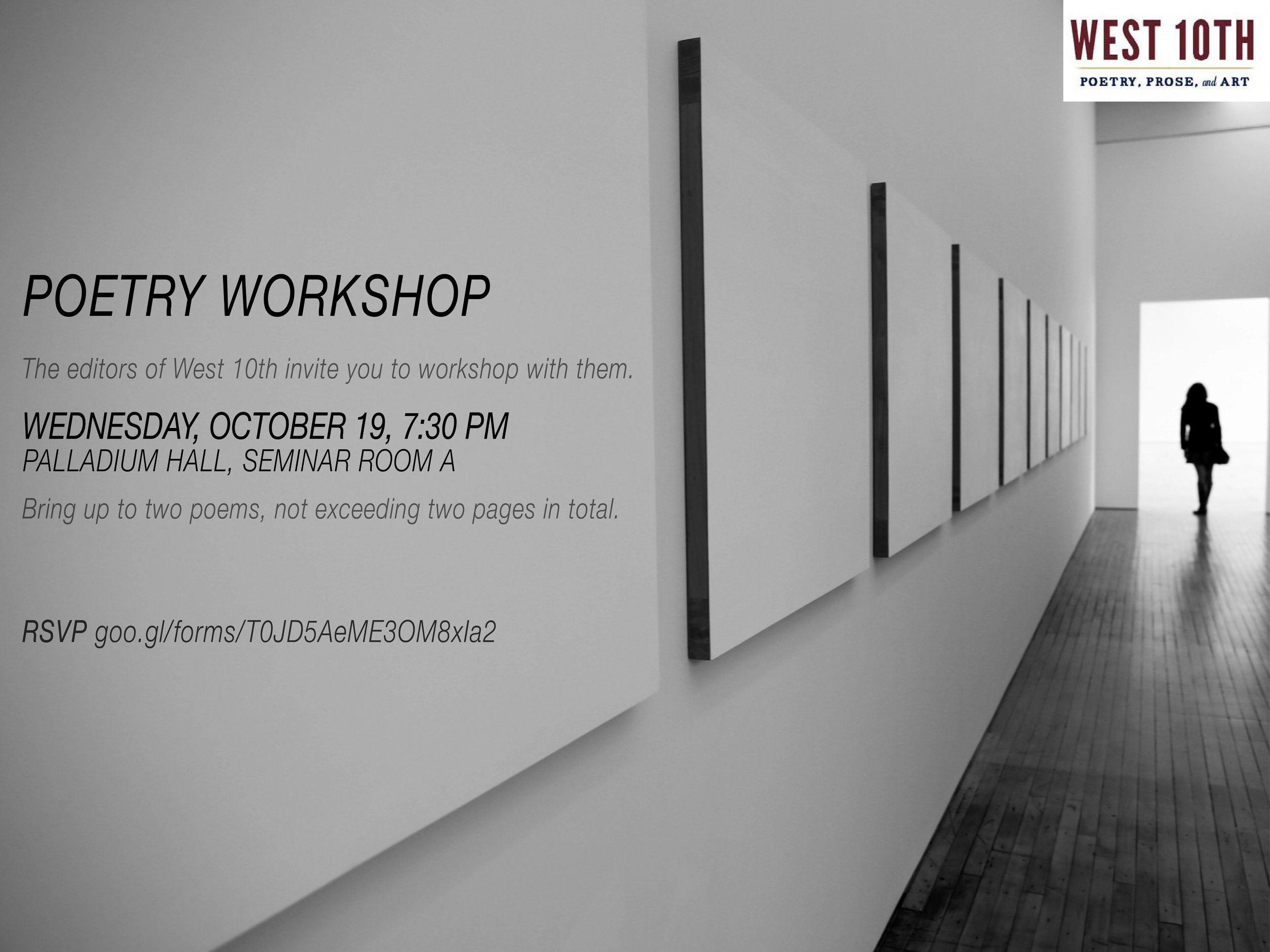 Bring up to two works of poetry (two pages maximum) to receive some feedback from your West 10th Editors. See you there!Just a reminder that we are still
  This workshop is open to all undergrad students! So bring up to 1500 words of fiction/non-fiction prose to receive some feedback and comments from your West 10th Editors.Just a reminder that we are still